Tapentadol vs Oxycodone: Which Painkiller Is Right for You?
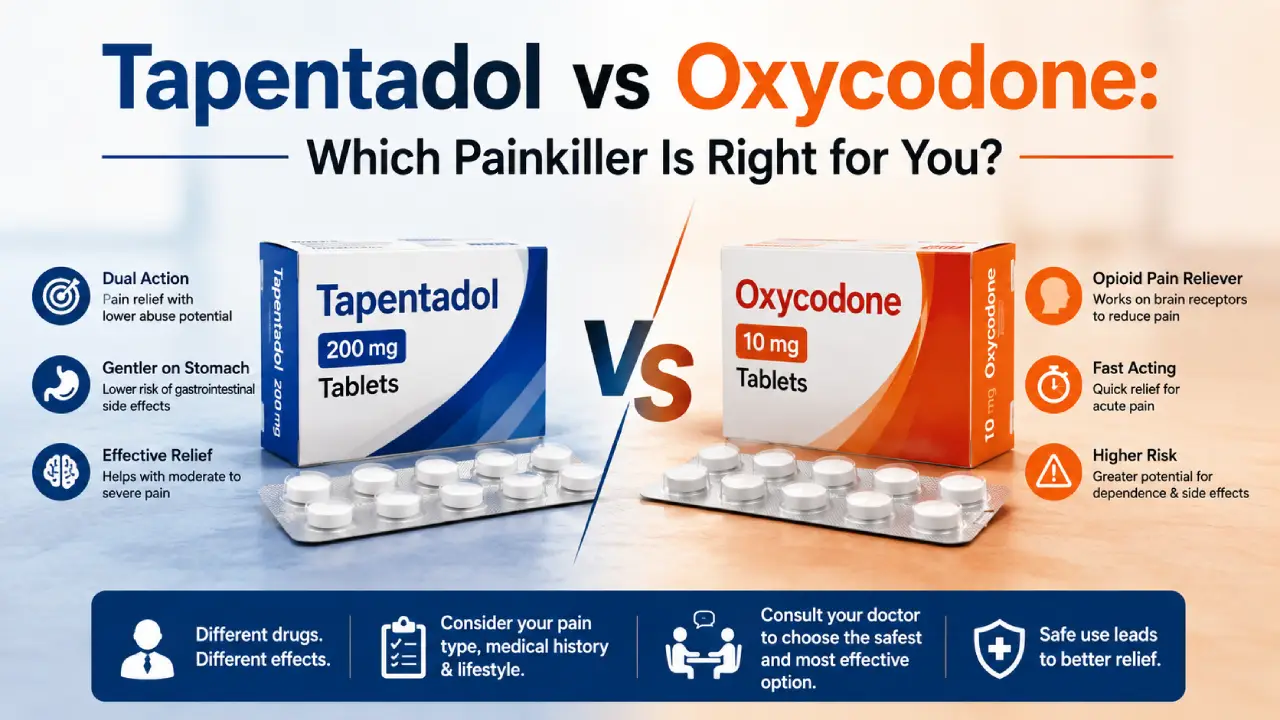
If you’ve been prescribed a strong painkiller, or you’re trying to understand a family member’s treatment, you may have come across two names that sound similar in purpose but aren’t quite the same drug: Tapentadol and oxycodone. Both are opioid analgesics used for moderate to severe pain, and both come up often when people search for Tapentadol vs Oxycodone comparisons online. This article walks through what each medicine is, how they differ, and what factors actually matter when a doctor decides between them. It’s written for general education only, not as a substitute for advice from a doctor or pharmacist, who can assess your specific situation.
What Is Tapentadol?
Tapentadol is a prescription opioid painkiller with a slightly unusual mechanism compared to older opioids. It acts on opioid receptors in the brain and spinal cord, but it also blocks the reuptake of noradrenaline, a neurotransmitter involved in how the body processes pain signals. That second mechanism is part of what sets it apart pharmacologically.
Doctors may prescribe Tapentadol for:
- Moderate to severe pain following injury, surgery, or trauma
- Some chronic pain conditions, including certain types with a nerve-pain component
It’s available only with a prescription in Australia, and it comes with the same category of warnings you’d expect from any strong opioid: sedation, risk of dependence with extended use, and the need for caution when combined with other medicines that affect the central nervous system.
What Is Oxycodone?
Oxycodone has been used in pain medicine for a long time and remains one of the more commonly prescribed opioids. Unlike Tapentadol, its action is more classic; it works almost entirely by binding to mu-opioid receptors, which reduces how the brain perceives pain signals.
It’s typically used for:
- Acute pain after surgery or serious injury
- Moderate to severe pain that hasn’t responded well to non-opioid options
- Selected chronic pain cases, always under medical review
Like Tapentadol, oxycodone is a controlled, prescription-only medicine. The risks are broadly familiar to anyone who’s read about opioids: drowsiness, constipation, tolerance over time, and, in higher doses or in combination with other depressant drugs, dangerous slowing of breathing.
Tapentadol vs Oxycodone
So what actually separates the two? A Tapentadol vs Oxycodone comparison isn’t really about which one is “stronger” in a general sense; that framing tends to be misleading. It’s more useful to look at how they behave differently in the body.
- How they work: Oxycodone relies almost solely on opioid receptor binding. Tapentadol adds a second layer, noradrenaline reuptake inhibition, which may explain why some clinicians consider it for pain with a nerve-related element.
- Clinical role: Both sit in the same general category (moderate-to-severe pain management), but the choice between them often comes down to the type of pain and how a patient has responded to opioids before.
- Side effect overlap: Nausea, dizziness, drowsiness, and constipation show up with both drugs, though not necessarily to the same degree in every patient.
- Dependence risk: Neither is exempt from the risk of physical dependence or misuse with prolonged or inappropriate use.
- Interactions: Both interact with alcohol and sedating medicines. Tapentadol carries an added caution around drugs that affect serotonin or noradrenaline levels, given its dual mechanism.
- What tips the decision: Kidney and liver function, other medications, age, and prior opioid exposure all factor into a prescriber’s choice; no fixed rule applies to everyone.
Tapentadol vs Oxycodone for Pain Relief
Ask ten different patients how well an opioid worked for them, and you’ll likely get ten different answers. Pain relief is genuinely individual, which is part of why Tapentadol vs Oxycodone for pain relief doesn’t have a single correct answer.
A few things shape the outcome:
- Acute vs chronic pain: short-term post-surgical pain is often managed quite differently from long-standing chronic pain, which usually needs a broader, more monitored plan.
- Cause and severity: nerve-related pain, musculoskeletal pain, and post-operative pain don’t always respond the same way to the same drug.
- Prior opioid use: someone who has taken opioids before may have built up some tolerance, which changes how a new medicine is introduced and monitored.
None of this can be worked out from a search engine. It requires an actual clinical assessment.
Tapentadol vs Oxycodone Strength
“Strength” is one of the most misunderstood terms in opioid discussions. People often assume it means you can line the two drugs up milligram-for-milligram and see which wins, but that’s not how opioid pharmacology works.
When people ask about Tapentadol vs Oxycodone strength, the honest answer is: it depends on far more than the number on the label. Relevant factors include:
- Individual tolerance and previous opioid exposure
- How each drug is metabolised by the liver and cleared by the kidneys
- Formulation, immediate-release versus controlled-release
- Overall health and any coexisting conditions
This article deliberately avoids giving dose-equivalence figures. Opioid conversions are a genuinely risky area of medicine, and getting them wrong can cause serious harm. That calculation belongs with a prescriber who knows the full clinical picture.
Tapentadol Uses and Side Effects
Understanding Tapentadol uses and side effects helps explain both why it’s prescribed and what to watch for while taking it.
Tapentadol is used for moderate to severe pain in appropriate clinical settings. Reported side effects include:
- Nausea and vomiting
- Dizziness or drowsiness
- Constipation
- Headache
- Respiratory depression, a serious risk, particularly at higher doses or alongside other sedating drugs
- Dependence and withdrawal symptoms if used long-term and stopped abruptly
Severe breathing difficulty, extreme drowsiness, or confusion are signs that need urgent medical attention, not a wait-and-see approach.
Oxycodone Uses and Side Effects
Oxycodone is prescribed for a similar range of pain conditions, under similarly close supervision. Possible side effects include:
- Drowsiness and sedation
- Nausea
- Constipation
- Dizziness
- Respiratory depression
- Tolerance building over time with continued use
- Dependence and withdrawal if the medicine is stopped suddenly without guidance
Key Differences Between Tapentadol Vs Oxycodone
Here’s a side-by-side summary, useful as a quick reference, though it’s no substitute for a proper clinical discussion.
| Category | Tapentadol | Oxycodone |
|---|---|---|
| Drug class | Opioid analgesic, dual mechanism | Opioid analgesic, mu-receptor agonist |
| How it works | Opioid receptor activity + blocks noradrenaline reuptake | Opioid receptor activity only |
| Typical use | Moderate–severe pain, including some nerve-related pain | Moderate–severe pain, including post-surgical pain |
| Onset considerations | Varies by formulation | Varies by formulation (IR vs CR) |
| Common side effects | Nausea, dizziness, drowsiness, constipation, headache | Drowsiness, nausea, constipation, dizziness |
| Serious risks | Respiratory depression, dependence | Respiratory depression, dependence, tolerance |
| Key drug interaction caution | Serotonergic/noradrenergic medicines | CNS depressants, respiratory conditions |
| Prescription status | Prescription-only | Prescription-only |
| Suitable for self-selection? | No, clinician decision required | No, clinician decision required |
Treat this as an orientation tool, not a decision-making one.
Which One May Be Appropriate?
There isn’t a universal winner between these two medicines, despite how often that framing shows up online. A prescriber typically weighs:
- Type and severity of pain
- Complete medical history
- Kidney and liver function
- Other current medications
- Past opioid response
- Personal or family risk factors for dependence
- Age and general health
- How the individual tolerates side effects
Switching between opioids, adjusting doses, or combining medicines without a doctor’s direct input isn’t something to attempt independently; the risks genuinely outweigh any convenience.
Important Safety Considerations
A short but important list:
- Alcohol amplifies sedation and breathing-related risks when combined with opioids.
- Sedatives and other CNS depressants (like benzodiazepines) can dangerously compound opioid effects.
- Driving or operating machinery should be avoided if a medicine causes drowsiness or impaired coordination.
- Respiratory depression is a genuine risk, especially at higher doses or in combination with other depressants.
- Dependence and withdrawal can develop with prolonged use; stopping should always be managed medically.
- Storage matters; keep opioids secure and out of reach of children.
- Never share a prescription opioid, even if someone else’s symptoms seem similar to yours.
Choosing a Safe Treatment Approach
Good pain management starts before the prescription is even written, with an accurate understanding of what’s actually causing the pain. From there:
- Be specific and honest with your doctor about your pain and its history
- Share a full list of medications and supplements you’re taking
- Stick to the prescribed schedule rather than adjusting it yourself
- Report side effects as they happen, rather than pushing through them
- Never use opioids that were prescribed to someone else
- Reach out for support early if you’re worried about dependence or misuse; the earlier this is addressed, the easier it is to manage
FAQs
1. What is the main difference between Tapentadol vs oxycodone?
Tapentadol works through opioid receptor activity plus noradrenaline reuptake inhibition; oxycodone works mainly through opioid receptors alone. Both are prescription opioids for moderate to severe pain.
2. Is Tapentadol an opioid?
Yes. It’s classified as an opioid analgesic and is a controlled, prescription-only medicine.
3. Is oxycodone stronger than Tapentadol?
There’s no simple answer; relative strength depends on dose, formulation, and individual factors. Only a prescriber can assess this for a specific patient.
4. Can Tapentadol and oxycodone be taken together?
Combining opioids isn’t standard practice and is generally avoided unless a doctor specifically directs and closely monitors it.
5. What are the common side effects of Tapentadol?
Nausea, dizziness, drowsiness, constipation, headache, and, in more serious cases, respiratory depression.
6. What are the common side effects of oxycodone?
Drowsiness, nausea, constipation, dizziness, and potential respiratory depression, particularly at higher doses.
7. Can Tapentadol or oxycodone cause dependence?
Yes. Both carry a real risk of physical dependence and withdrawal symptoms, especially with prolonged use.
8. Should you switch from one opioid to another without medical advice?
No. Switching requires a proper clinical assessment, since dosing, side-effect profiles, and safety considerations differ between the two drugs.
Conclusion
When it comes to Tapentadol vs Oxycodone, both are effective prescription opioids for moderate to severe pain, but they aren’t interchangeable, and neither one is objectively “better” across the board. Their differences in mechanism, side-effect profile, and clinical fit mean the right choice depends entirely on the individual, their type of pain, medical history, other medications, and how their body responds to treatment. The safest path is the same regardless of which medicine is being considered: work closely with a doctor or pharmacist, stick to the prescribed plan, and raise any side effects or concerns as soon as they come up. Pain management works best as an ongoing conversation with a healthcare professional, not a decision made in isolation.
Medical Disclaimer: This article is for general educational purposes only and does not replace professional medical advice. Tapentadol and oxycodone are prescription medicines requiring appropriate medical supervision. Always consult a qualified healthcare professional about your treatment options.
| Field | Details |
|---|---|
| Written By | Dr. Michael Anderson |
| Checked By | Dr. Daniel Thompson |
| Published Date | 31 August 2026 |
| Next Reviewed | January 2027 |
| Category | Sleep Health |
| Reading Time | 7 min |